
Listen to it on
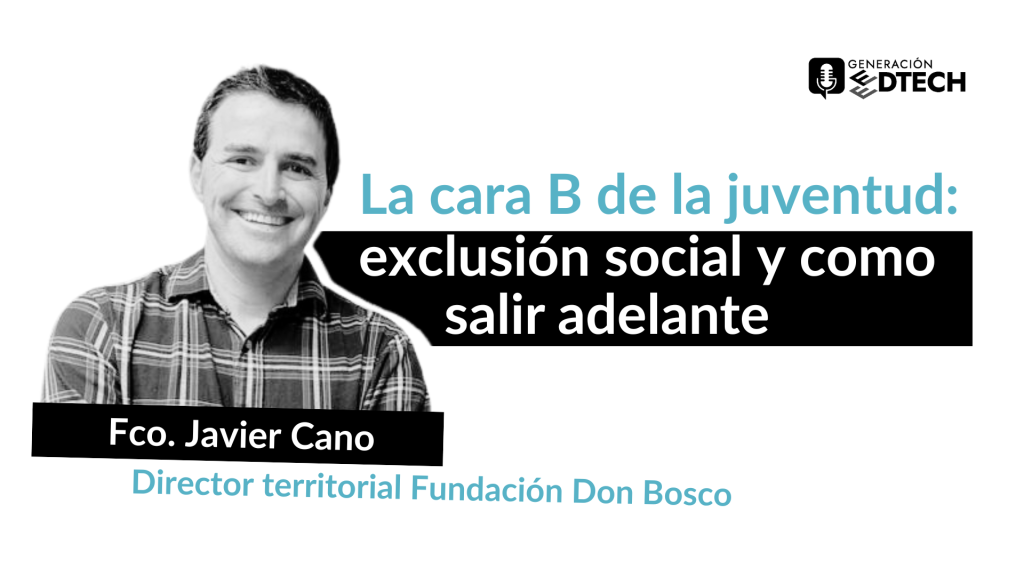
Francisco Javier Cano
When we talk about people in risk of social exclusion, we’re not talking about statistics. We’re talking about real lives. About individual names, silenced stories, and obstacles that aren’t chosen but are inherited. In this new episode of the podcast, we’re joined by Francisco Javier Cano from Don Bosco Foundation, a professional committed to social inclusion and an advocate for the rights of those who face the greatest challenges.
The discussion centres on a key question: What does it really mean to be at risk of social exclusion in today’s world? And what can we do – through education, public policy and community action – to change that reality?
Much more than just poverty
“The risk of exclusion is not just an economic issue. It means having no access, no voice and no network,” Francisco Javier Cano states emphatically.
The fact is that being at risk of exclusion often means living in precarious circumstances across many areas of life: housing, employment, mental health, education and social participation. Exclusion is not just about being left out of the system; it is also about the system failing to see you.
Education as a turning point
One of the episode’s strong points is the role of the education as a tool for inclusion. Cano insists that “schools cannot limit themselves to teaching the curriculum. They must be safe spaces that identify and provide support in situations of vulnerability before they become chronic”.
In this regard, the role of the educator is recognised not only as a transmitter of knowledge, but also as a key agent of social justice – a bridge between the institutional and the human.
Listen, include, transform
The episode also provides an opportunity to reflect on the role of institutions. Cano calls for more flexible and personalised public policies:
“You can’t tackle exclusion through a one-size-fits-all approach. Every situation requires a different approach.”
Drawing on his experience, Francisco Javier Cano emphasises the importance of building networks between social organisations, professionals in the fields of education, psychology and social work, and, above all, the people at risk themselves. Because inclusion cannot be imposed: it is built collectively.
A society that leaves no one behind
To turn a blind eye to the risk of social exclusion It doesn’t make it go away. Listening, raising awareness and taking action can make a real difference. This episode is a powerful reminder that no structural change is possible without putting the most vulnerable people at the centre.