

Listen to it on
R Ladies
The world of programming is changing fast – very fast – and even more so now that new artificial intelligence tools are making life easier for… well, all of us. But it’s true that there is perhaps one area in which the programming sector – and the tech industry in general – isn’t evolving as quickly as it should: inclusion.
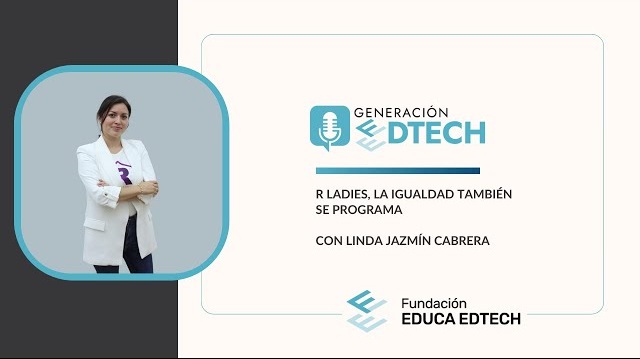
According to the National Observatory for Telecommunications and the Information Society, women account for around 20% of all ICT specialists in Spain, a figure that drops to 10 or 11% when it comes to female programmers or software architects. There is still a great deal of work to be done in the area of equality, and Linda Cabrera, a Data Analyst at EDUCA EDTECH Group and a member of the R-Ladies community of female programmers, is well aware of this.
Find out all about what we do at: https://educaedtech.foundation/
Transcript
In the world of programming, everything changes rapidly, especially with the arrival of new artificial intelligence tools that make many people’s work easier. However, there is one area in which the programming sector – and the technology sector in general – is not evolving as quickly as it should: inclusion and equality. According to the National Observatory for Telecommunications and the Information Society, women account for around 20% of all ICT specialists in Spain, a figure that drops to 10–11% when it comes to female programmers or software architects. Clearly, there is still a great deal of work to be done in terms of equality. This is a reality well known to Linda Cabrera, a data analyst at Educatech Group and a member of the R Ladies community of female programmers.
Linda explains that R Ladies is a community that promotes gender diversity around the world. It was founded in 2012 on the initiative of Gabriela de Queiroz, who, having noticed that the majority of programming events she attended in the United States were dominated by men, decided to set up the first R Ladies group in San Francisco. Since then, the movement has grown and now has more than 140 chapters in 48 countries. In Spain, there are active chapters in Madrid, Barcelona and Bilbao, where a collaborative support network is being built amongst all the participants.
The R Ladies group focuses on three key pillars: creating a safe space for all women, promoting the inclusion of anyone interested, and fostering respect and patience at workshops and events. Although anyone can attend these workshops, the speakers and organisers must be women. Linda joined the group about three years ago, after completing her master’s degree in mathematical research and deciding to dive into data science. For her, being part of R Ladies has meant dedicating several hours a week to organising workshops and events, which she considers a valuable investment in her personal and professional growth.
Linda emphasises that one of the biggest challenges facing the world of software and technology is narrowing the gender gap in STEM subjects (science, technology, engineering and mathematics). Women are under-represented in this field, which can lead to the creation of biased products and services due to a lack of diversity. According to a UN study, the main cause of this gap is gender stereotypes instilled from an early age, such as the classic division between dolls and footballs. These stereotypes influence people’s educational and career choices, perpetuating a vicious circle.
To tackle this problem, Linda suggests that it is essential to involve both boys and girls in activities such as robotics or coding clubs from an early age. It is also crucial to provide them with female role models who demonstrate that it is possible to succeed in any field, regardless of gender. At R Ladies, they promote this kind of inspiration through talks and lectures given by women who have achieved success in their respective fields.
Although progress has been made towards greater gender equality, there is still a long way to go. Communities such as R Ladies, Women in Tech, PyLadies and others are actively working to reduce the gender gap in technology. Linda acknowledges that in Spain there is still a long way to go and points out that artificial intelligence has also had an impact on the R community, with the creation of AI tools and packages that have expanded the possibilities for using the R language in data analysis.
On the subject of artificial intelligence, Linda comments that, although it may seem like a threat to certain jobs, it should actually be seen as a challenge. AI tools still require human oversight, particularly to avoid biases such as those that have been highlighted in facial recognition technologies. Whilst some jobs may become obsolete, new opportunities will be created as the technology advances.
To conclude, Linda calls on parents of young girls to challenge gender stereotypes and encourage their daughters to explore different fields, including STEM. She also encourages women who are already in the world of programming to join communities such as R Ladies, where they will find a network of support and learning. Her final message is clear: if you travel alone, you may get there faster, but if you travel with others, you can go further.
[/bg_collapse]