

Listen to it on
Mental health
Little by little, mental health is ceasing to be a taboo subject and is beginning to gain visibility in a society that is increasingly calling for measures to tackle what may well be one of the pandemics of this century. Not so long ago, saying something like… “I’m going to see a psychologist” was daunting; it meant bringing up a subject that wasn’t discussed in public: mental health issues.
Fortunately, things are starting to change. From celebrities to top-level sportspersons – whom we have always looked up to as role models for strength and mental discipline – people are now publicly acknowledging that there’s nothing wrong with raising a hand and asking for help.
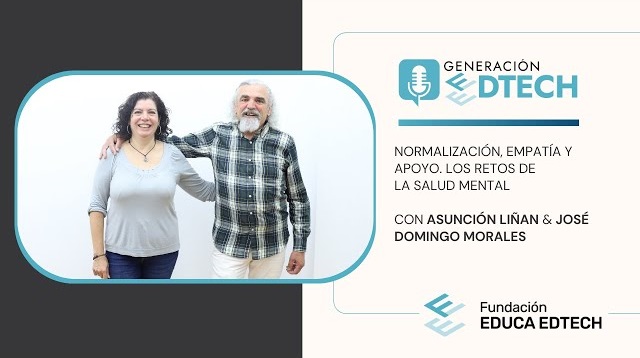
That is precisely what the SAPAME association is dedicated to: providing support to people suffering from mental health conditions, whilst combating the stigma that has historically been associated with them. Don’t miss this new episode of ‘Generación EdTech’.
Find out all about what we do at: https://educaedtech.foundation/
Transcript
Little by little, mental health is ceasing to be a taboo subject and is beginning to gain visibility in a society that is increasingly calling for measures to tackle what may well be one of the pandemics of this century. Not so long ago, saying «I’m going to see a psychologist» was a daunting prospect. It meant bringing up something that wasn’t discussed in public: mental health issues. Fortunately, things are changing. From celebrities to elite sportspersons – whom we’ve always looked up to as models of strength and mental discipline – are making it clear that there’s nothing wrong with raising your hand and asking for help.
That is precisely what the SAPAM association is dedicated to: providing support to people suffering from mental health conditions, whilst combating the stigma that has historically been associated with them. So today I’m joined by Asunción Liñán, president of SAPAME, and José Domingo Morales, treasurer — or rather, former treasurer — and one of the founding members of this association. Welcome, Asunción, Sensi and José Domingo, to our Generación Tec podcast.
[bg_collapse view=»link» colour=»#53AFC4» icon=»arrow» expand_text=»Read more» collapse_text=»Close» inline_css=»text-align: centre; display: flex; justify-content: centre; width: max-content; margin: 10px auto; padding: 4px 12px; background-colour: #53AFC4; colour: #fff; border-radius: 6px; gap: 3px;” ]
Well, it’s high time we laid out everything that’s going on regarding mental health issues, because here’s a statistic: around a third of the population in Spain say they suffer from some form of mental health condition, across the entire spectrum, from the most serious conditions right through to stress, depression and so on. Do you think this is finally changing and that there really is less stigma attached to talking about mental health conditions?
«I’d say very slowly. There’s still quite a lot of stigma. The thing is, it’s true that people are talking about it a bit more. I think that since the pandemic, there have been a lot of cases of depression, anxiety attacks and so on affecting people, and there’s been a bit more talk about mental health, which is always important to bring to the fore. There are also celebrities, as you mentioned earlier, who have come forward to say that they have some kind of mental health condition. And, well, people are trying to normalise it a bit, but there’s still a long way to go.»
There’s still a long way to go, isn’t there? And the media are also talking more about mental health, although on the other hand they also perpetuate the stigma; there are times when they do that, aren’t there? But, José, are we aware of just how important and serious the situation is for a large part of the population who have these kinds of problems, or are we still unaware of that reality?
«I think we’re getting there bit by bit. In fact, I believe that, at government level and within institutions, steps are already being taken to tackle stigma and improve mental health care. I do think things are changing.»
Well, and among other things, thanks to organisations like yours, like SAPAME. Sensi, tell me a bit about what it involves. What do you get up to on a day-to-day basis at SAPAME?
«We are a not-for-profit association, run by the members themselves, and – most importantly – we are involved first-hand; in other words, it is not family members who come here, but we, the mental health service users, who take part in this association. We fight to defend our rights, to promote social inclusion, and to support recovery through a plan for an independent life that is tailored to the individual’s wishes. That is precisely why we are a »first-person’ organisation. We organise many activities to help us integrate a little more and break out of our isolation.”
«We run workshops – to be honest, it’s quite a long list: mindfulness, yoga, biodanza, painting, reading, theatre… There are two different psychologists running two separate workshops, as well as IT, music therapy, a multi-purpose workshop, hiking and, above all, the mutual support workshop, which is very important. It’s mutual support amongst peers; it’s not run by any professional – it’s us, the service users, who provide this support to one another. Everyone shares their problems and we empathise deeply. Although we don’t give advice, we say things like, ‘Well, something similar happened to me, and this is what I did’ or ‘We really relate to that’. It’s a safe space where, when you arrive, you realise you’re not a weirdo. You see that there are other people with the same issues as you, and then, to be honest, people really do open up.»
«Often, at first, people come with family members because they aren’t quite independent enough, and, little by little, you see them starting to come on their own – they’re a bit more independent, they open up more, they talk more, and they keep coming. Simply having a routine, having a reason to get up in the morning and say: ‘Ah, well, I’m going to do things, I’m going to see people’. There, they usually make quite a few friends; we’re like a second family, really. The activities help us to socialise. To that end, we also have cultural visits, which some family members sometimes come along to as well. And then there are the trips we organise with a local company here in Granada. We organise trips as well; we’re off to the Costa Brava next, and then to Palencia, with a good-sized group from SAPAME. And that helps us, because one thing that can happen is that we end up shut away at home, not wanting to go out, and this helps us socialise and get out and about.»
«Sensi, you talk about empathy, and I suppose that’s very important in an organisation run by the users themselves.»
«We have empathy because we’ve all been through similar problems, even though we each have a different diagnosis – as there are many different mental health conditions – but we’ve always gone through similar experiences. It’s funny now because we’ve made some short films to combat stigma – they’re like mini-shorts – and, for example, at the end, we put the title ‘You can tell’. One of the shorts was about, for example, walking down the street and thinking that everyone is staring at you, talking about you, laughing at you. That’s something very typical that we’ve all experienced. So, when people arrive at SAPAME, the first thing we do is welcome them. We have a social worker who, as it happens, is also a service user herself. She conducts the initial intake, and that’s where people explain what’s going on for them – although we don’t ask for a medical report on their condition or anything like that – but they do share a bit about their situation so we can see if SAPAME is the right fit for their needs. We work through that and she then provides support throughout the whole process. When someone stops coming – they’ll turn up for a while, then go a long time without coming – we try to ring them to see what’s happened, or if they’re unwell. We keep in touch with them.»
[/bg_collapse]