

Innovate in internal team training
It is no coincidence that three technology companies have come together to organise a round-table discussion on innovation; however, this R&D&I is not so much about technology as it is about innovation involving people.
Perhaps, precisely because they work with technology, these companies are more aware of the importance of people and their training. That is why, at EDUCA EDTECH Group, we have organised a round-table discussion on innovation in staff training, an area that has increasingly become strategic for maintaining companies’ competitiveness.
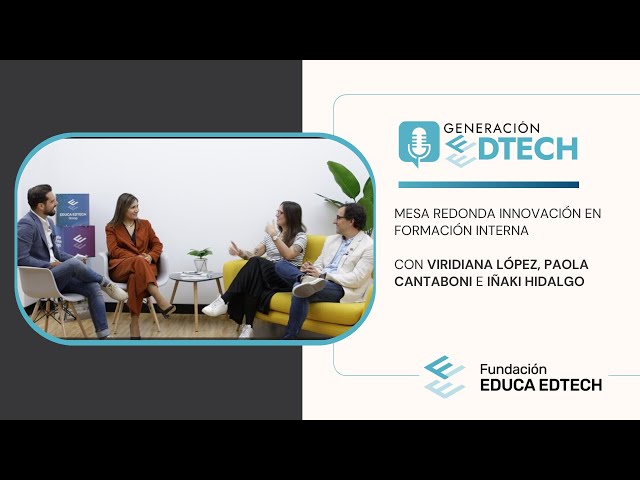
Iñaki Hidalgo, Head of People & Culture at Civica; Paola Cantaboni, Head of People & Culture at Novatech; and Viridiana López, CHRO of the EDUCA EDTECH Group.
Welcome to a new episode of Generation EdTech, the podcast from the EDUCA EDTECH Foundation. Find out more about what we do at: https://educaedtech.foundation/
Transcription
Today I have to stay at home and tomorrow I don’t, but I think the trend of putting a face to the brand and offering some sort of training in companies that operate that way is going to make a comeback, because whatever the reasons may be – but in our case it’s: «Hey, the space we have is cool, it’s comfortable, it’s welcoming, you’ll meet other people, and you’ll be able to have breakfast there. You have all the resources you need for whatever you need, a comfortable space where you’re the one who decides whether to come into the office.» And in some ways, Mondays are a bit trickier, but as the week goes on, it’s true that it’s happening. We’re starting to see people asking for spaces where they want to be and be able to socialise. And it’s funny, isn’t it? You were anticipating this trend of wanting to meet up again. I think it’s about unlearning what we’ve learnt during the pandemic. We’re realising that we have people all over Spain, just like them, and although we only have the office in Granada, people want to get together again.
So, for example, in the leadership training we’ve set up a fun budget so that when they’re here for training or for the usual summer or winter parties, they can use that budget to do other things together, like go bowling, or the other day they went to that axe-throwing place. I said, ‘That axe thing is a bit dangerous.’ And what’s the axe thing? It’s a bar, a pub, where you can throw axes, basically. Don’t tell the health and safety officer about that – we didn’t mention it; it’s strictly outside of work. But ultimately, it’s one thing to chat to each other on Teams or Google; the desire or need for interaction with another department is different. But as soon as you have a drink or take part in an event, you start to see the person as a human being.
[bg_collapse view=»link» colour=»#53AFC4» icon=»arrow» expand_text=»Read more» collapse_text=»Close» inline_css=»text-align: centre; display: flex; justify-content: centre; width: max-content; margin: 10px auto; padding: 4px 12px; background-colour: #53AFC4; colour: #fff; border-radius: 6px; gap: 3px;"]
Villena, if you’d like to comment…
-Absolutely. Besides, it’s very much in keeping with our approach. It’s true that we put in place all these measures that might seem a bit like «forcing» things, but it isn’t forcing because, ultimately, they love this space where they can spread out a bit more and relax. We came up with our «Friday» sessions so that we could get to know each other on a personal level, to start empathising with other people and with other departments. What’s more, there’s always that typical interdepartmental friction – often there are disagreements – but then you meet up and discuss it in a different setting, and everything gets sorted out in the end.
So, there is also this aspect of being able to incorporate the human element – the part of socialising that cannot be taken away from us – and take it to that level. The truth is that it is difficult; the answer is complicated. Yes, but well, ultimately I think common sense should prevail in this case, and we know a great deal about that. We try to emphasise this a great deal in Civica in this context as well. That is to say, as the saying goes: «The virtue of asking is not in receiving», or «The virtue of asking lies in knowing how to give». Well, we’re talking about many things, many different types of training and knowledge.
And please don’t let any customer get lost. That’s where common sense comes in. The day a Russian, Swedish, American or Belgian customer comes in, you’ll be the first to sign up for classes so that you can provide the necessary support. So where are the limits? Well, you have to use a bit of common sense. And that’s where we try to explain: «Listen, I’m sure you’ll get what you’re asking for, but right now we have to prioritise other things». Seeing someone who’s proactive – and who also brings a lot to the company – it’s a joy to see that this person wants to grow because they’re contributing in this way.
Obviously, when we conduct the interview, we tell them, «Look, you’ve got this hour of training, OK? It’s related to the job. Because if he asks for Japanese cuisine, the answer might be «no». That’s not to say we might not organise a team-building workshop on Japanese cuisine, but…’.
Just a few of the results – the progress is a bit… it doesn’t quite add up to what you’re saying. Of course, there has to be a strategy. And at Viridiana, with 800 of us working here, the strategy has to be very clear, doesn’t it?
-Yes, let’s see, the strategy… and well, that’s what I was saying at the start. We have a very clear direction and a very clear plan, but we have to adapt that plan quite a lot because so much happens over the course of a year. And then a client or a specific project comes along that requires a different kind of training, even though that wasn’t what they’d specifically asked for to begin with. And then it also has a lot to do with the level of engagement the staff show in this regard, because it’s true that there’s a bit of everything: there are people who ask for a lot, but then they don’t get involved to the extent that would be best for their professional and personal lives.
Finally, we do indeed have a track record, but the employer might be a bit unsure. Here again, internal communication is key – knowing how to convey all this. That’s right. In fact, as we were discussing earlier, when you first join Civica, you work with your practice leader to map out that «career path» – the trajectory you’ll follow at Civica during your time there. From that point on, it’s true that on your first day you have 40,000 things – 40,000 pieces of information and training content organised by topic – all available to you.
Indeed, internal communication and regular communication sessions help to remind you that this is available and that you can keep doing it. The practice leaders say the same thing in their meetings with the teams: «Hey, I can see we’ve got some documentation here that you haven’t looked at yet.» You really do need to be constantly reminded, exactly. It’s the reminder; it’s the best way to try to… we have an intranet and a monthly newsletter. In the newsletter sent out by marketing, we list all the birthdays, what’s been achieved, who’s joining us, the vacancies… and we include a little nudge. For example, in the last newsletter we said: «Let’s see if people scroll all the way to the bottom» – we included «pizza taster» amongst the job vacancies. Let’s see if people get that far.
Or the intranet – which is very difficult for someone who’s a «people lead» – they have a coffee break once a week where they discuss new developments, and the «people leads» tell them: «Hey, there’s this new thing – do you know about it? And anyone who asks can direct you to where you can find the information or provide it to you directly. It’s essential. Iñi highlighted a tool you’ve developed yourselves, which I think is very interesting. Here at home, we’re also looking at how to keep communicating and ultimately reach our target audience, who are the staff.
We develop it and run it past a whole host of people from the marketing, communications and human resources teams, to ensure that the message conveys what it needs to and does so in a way that people will find engaging. And finally, Edys – this tool that helps us share information… well, I’d say Edys, but I could also mention this network of mentors, because people often get lost amongst all the tasks they have to do. You don’t know where to find it, or you can’t remember how to access the tool, and ultimately the mentors provide that guidance so that people can be steered in the right direction, because very often the success of new recruits depends heavily on this support.
Because when someone is very good at what they do, if you don’t know how to let them know if they have a doubt and they just let it go… we’re particularly proud of this story. I think the knowledge sessions I mentioned at the start have been a success for many reasons and are proving very popular. It’s true that they’re held on Fridays at the last minute, just before the weekend begins, which also helps. That also helps, just before the three o’clock beer, but I think it’s a space where those people who have signed up for these sessions… it’s very difficult to talk to them, even if they’re a colleague giving a talk – someone who isn’t a boss, who isn’t the CEO, who isn’t a director. So, you feel much more connected to that person, and I think it has helped a great deal to… well, not only to talk about technology, but also about other topics.
How lovely – in our case, you mentioned the Happiness Lab. I’d say that a year ago we started creating a happiness calendar, Niconico. It’s partly inspired by holiday traditions and Christmas – they’ve included a Father Christmas and some red, and it’s for days when things haven’t gone so well. And we have a team called the Feel Good team, which consists of two developers – myself included – but they spend some of their time helping out a bit with people management: «Hey, maybe there are things I don’t want to discuss with my line manager, for whatever reason.»
So, looking at the calendar, you might say, «Hey, this person’s been in the yellow zone for a few weeks, verging on orange – let’s see if we can have a chat with their account manager and the Feel Good team to see if we can do something with them.» We’ve seen several cases where things have got a bit stuck. It’s just been complicated, because it’s not like being in the office and not knowing if someone’s come in. It’s a bit of a mix, isn’t it? We mustn’t forget that. Then, speaking of motivation – of motivations beyond technology – we’ve also launched a Friday session called «Friday Free», where everyone can talk about whatever they like, as long as it’s of value to someone else in the company.
[/bg_collapse]