

Listen to it on
Artificial intelligence
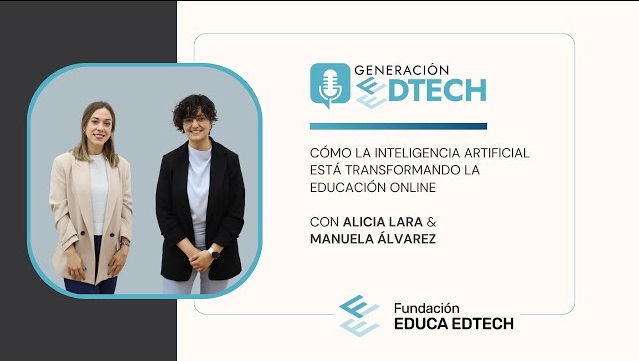
In recent months, artificial intelligence has become one of the key tools for innovation in virtually any field. Perhaps one of the areas set to benefit most immediately is online education, a sector that already boasts advanced technological developments and has access to vast amounts of data to feed into AI algorithms. We’re discussing these algorithms today on Generación EdTech with Alicia Lara, Chief Data Officer, and Manuela Álvarez, AI Project Manager, who are both responsible for driving the development of artificial intelligence tools at the EDUCA EDTECH Group. Would you like to know how AI is set to transform the way we learn? Don’t miss the latest episode of Generación EdTech. This is an outreach project by the EDUCA EDTECH Foundation. Find out all about what we do at: https://educaedtech.foundation/
Transcript
Artificial intelligence (AI) is transforming many aspects of our lives, including online education. Although many people associate it with the generation of text, images or videos, AI is much more than that. It is present in fields as diverse as medicine, research into new materials, the development of renewable energy, and, of course, education. At EducaTech Group, for example, AI tools are developed and implemented to assist both teachers and students, demonstrating how this technology can transform the teaching and learning process.
Understanding what’s out there and educating society about what’s to come – about what already exists, but also about what lies ahead. Before, you could also record videos and upload them to Instagram – videos that weren’t appropriate. Now, the question is: «Can you create videos?» Well, we’re in the same situation. The key is what you’re going to do with it and how you’re going to regulate it.
To take a more positive view of the use of artificial intelligence tools, as you know, the EducaTech Foundation is working to build a more equitable society. How can AI help us achieve a better society for everyone? What examples or ideas can we offer in this regard?
[bg_collapse view=»link» colour=»#53AFC4» icon=»arrow» expand_text=»Read more» collapse_text=»Close» inline_css=»text-align: centre; display: flex; justify-content: centre; width: max-content; margin: 10px auto; padding: 4px 12px; background-colour: #53AFC4; colour: #fff; border-radius: 6px; gap: 3px;” ]
Examples can be given at many levels. In the field of education – which is what we know best and what we work on every day – we try to personalise the learner’s experience. One area where AI could be very useful is in adapting educational content to each person’s abilities. Not everyone has the same abilities. So, if you adapt the content to each learner’s abilities, they’ll probably learn better. I’m not just talking about physical disabilities, but also psychological ones.
AI, through text generation, could be capable of summarising or simplifying language – tasks that are extremely useful. At the Spanish Society for Natural Language Processing, for example, competitions are held every year that tackle several of these tasks. There are other applications, such as the anonymisation of clinical documents. Firstly, it is necessary to anonymise the data in order to analyse it and identify patterns.
There are many ways in which AI can be incredibly useful to society, even if they are not always obvious. The key is to provide people with exactly what they need to achieve their goals, using the tools available. Whereas before we only had computers and basic statistics, we now have tools that have proven to be useful. Although they are still limited and we do not know how far they will go, they are growing exponentially. To keep up to date, you have to study constantly.
We are making a statement of intent: two women driving the development of Artificial Intelligence in a sector that has historically been male-dominated. I hope that, in five years’ time, I won’t have to ask this question, but today, unfortunately, I have to: Do you feel that there is still a gender gap in the sector and that, as women, you face certain additional problems or difficulties?
Well, it’s clear that this isn’t the case within EducaTech, because here we are. But it is true that we’re surrounded by many male colleagues, and that’s a reality. Even so, I believe that, as a society, we’re making progress and evolving, although perhaps not quite as quickly as technology. We must be aware that we have a great responsibility and a lot of work to do in this regard. Little by little, we’re improving, and there are more and more women and girls who are motivated and keen to study subjects such as data science.
I feel that the gap that used to exist isn’t quite as wide anymore. We’re not going to deny that it exists, but in my own personal situation, I haven’t had that problem. I’ve been lucky, and that’s the difference. The gap starts when you’re a child. The problem arises from childhood, because, ultimately, when you’re an adult, a company doesn’t care whether you’re a man or a woman; what matters is what you do and what you know.
However, there is a notable difference when it comes to childhood. Traditional gender roles in early childhood are difficult to eradicate. Although there is still a great deal of work to be done, many initiatives are being launched to promote women’s participation in data science, particularly to encourage young girls to enter this field. At EducaTech, for example, we have a colleague in another department who is involved in one of these initiatives.
A lot is being done. The key is to educate from an early age – not just the child, but society as a whole. Most of the gaps stem from within the home, not from outside. The good thing is that AI doesn’t recognise gender; what matters is how far it goes and what you want to do with it.
I love it. Well, one last question I just can’t resist asking. Speaking of Artificial Intelligence and its exponential growth, two years ago hardly anyone knew what ChatGPT was – it was only known in very small circles. Today, everyone has used it or is using other content-generation tools. Where are we heading, or where will we be in five years’ time?
Five years is a long time in the world of technology. Five years ago, in the field of natural language processing, we had far less than we do now. I’m talking about natural language processing because that’s where ChatGPT comes in, but there are many other areas of research. To be honest, I don’t know where we’ll end up. I don’t have – though I wish I did – that key to solving all the unknowns, but we do know how things are evolving.
Progress is being made both in terms of the computational requirements for training these models and in our understanding and use of the tools. There are people with great ability and ingenuity when it comes to making the most of these tools, and I believe that if AI is already integrated into society, it will become even more so. At the moment, I think it’s already very much integrated, but we’re not fully aware of it because we tend to view it more as systems. What used to be statistical systems – I believe that in five years’ time we’ll be much more aware of their scope.
Brilliant. Well, Alicia and Manuela, thank you so much for joining us today. I think we’ve given a very interesting insight into what Artificial Intelligence is, not just in terms of the big ideas, but also as it applies to online education. Thank you very much, and see you next time.
[/bg_collapse]