

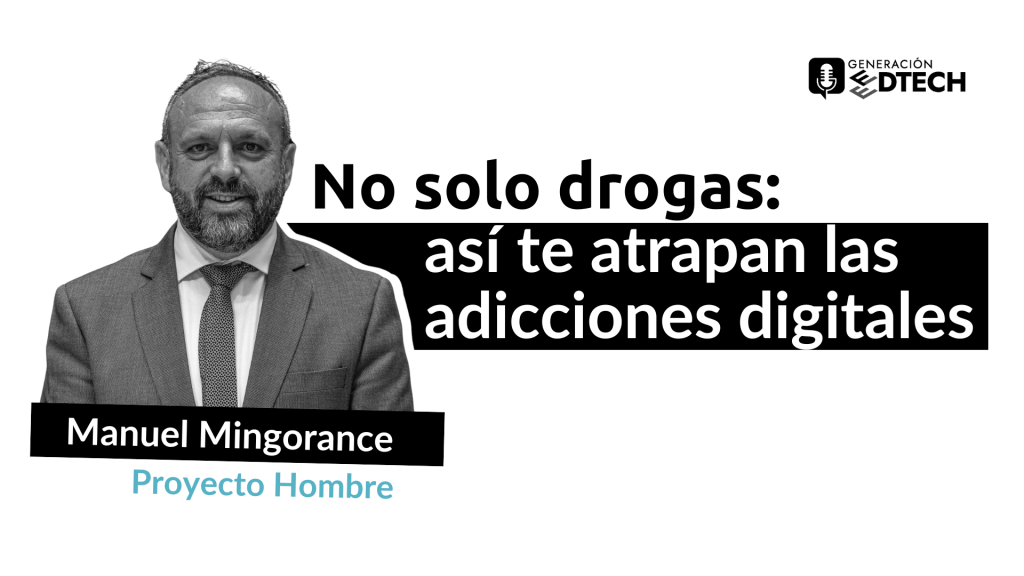
- In this third episode of Generación EdTech, Manuel Mingorance, director and chairman of Proyecto Hombre Granada, explains the organisation’s approach to the rehabilitation of people with addiction problems.
Founded in 2000, Proyecto Hombre Granada has a track record of more than 20 years working day in, day out to treat and prevent addiction in this province.
On this occasion, we are joined by EdTech Generation Manuel Mingorance, chairman of Proyecto Hombre Granada. in a conversation centred on the issue of addiction in today’s world. Throughout the interview, which is Available on Spotify, YouTube and Apple Podcasts, Mingorance highlights how addictions have evolved, bringing together both the «old ghosts» – such as alcohol and drugs – and the «new addictions» technology-related.
«We live in a society of constant stimuli that seeks immediate gratification. We rely on consuming all sorts of things – whether they are substances or not – just to keep up. This will lead to problems in a few years» time.’
But we’re not just talking about the future; the president of Proyecto Hombre also analyses the current situation, which is characterised by the «lack of public outcry» and a lack of awareness.
«In the 1980s, there was a real public outcry, and that led to the formation of many organisations. Today, that outcry no longer exists, but there is a very serious problem with addiction. There are thousands upon thousands of people who have an addiction problem and do not seek help, which can lead to suicide. In 2002, there were 4,003 suicides, which shows a failure to deal with these problems.».
Mingorance helps us to to outline the different profiles of a person with an addiction. With a marked difference between men and women in the province, of a 19% compared with the 81% for men.
«I believe that, deep down, an addict is someone who is out of step with their surroundings. From a young age, they may have experienced family breakdown, been bullied or suffered from low self-esteem. They have not had sufficient personal and social skills to cope with life.»
Regarding the recovery rates and the programmes being run by Proyecto Hombre, its chairman tells us that they may have a lasting around a year and a half, until he is given the high therapeutic value.
«When we discharge a patient following treatment, there is an 85% success rate with no relapse, and the majority reintegrate into society and the workplace. A person who has fallen and got back up is stronger than one who has never fallen.«
To conclude, Manuel Mingorance calls on us to reconsider the current situation. According to figures from the World Health Organisation, every year there are 2.6 million deaths attributable to alcohol consumption and more than half a million due to the use of psychoactive substances.
That is why, in this episode of Generación EdTech It emphasises the importance of asking for help, seeking professional support and, ultimately, to live happier lives, being in control of our own lives.