

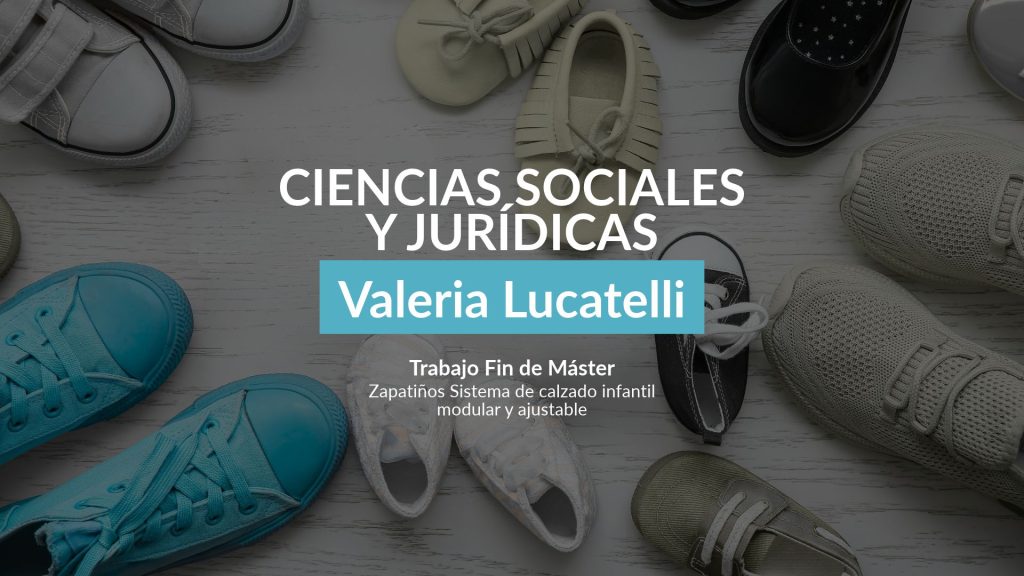
There is a problem that almost all families with young children are all too familiar with: shoes become too small before they’ve worn out. Feet grow, shoes are discarded, and the cycle repeats itself every few months at a rate that takes its toll on both the household budget and our environmental conscience. Valeria Lucatelli, recognised in the Social and Legal Sciences category at the EDUCA EDTECH 2026 Foundation’s Academic Excellence Awards, decided there was a better way of doing things.
An everyday contradiction
The starting point of Little shoes It is as simple as it is powerful: families discard children’s shoes that are still in perfect working order simply because the child’s foot has grown, not because the shoe has worn out. This contradiction is repeated millions of times a year, and no one had yet found a structural solution to it.
The figures underscore the scale of the problem. A child’s foot grows half a size every two months until the age of two. No existing category of footwear offers a solution to this rate of obsolescence. And families are well aware of this: a survey conducted by Valeria amongst 29 parents with school-age children revealed that 82.8% have found that their children quickly outgrow their shoes, that 58.6% rated the idea of adjustable footwear 5 out of 5, and that 86.2% believe it is worth paying more for a shoe that lasts longer.
The technical solution
Little shoes It proposes a modular and adjustable footwear system for children aged between one and six, designed for the summer season, capable of adapting to at least two consecutive sizes without the need for tools.
At the heart of the system is a segmented sole comprising modules spaced 8 mm apart, joined by interlocking joints and 4 mm-diameter threads, in three length configurations: 157, 165 and 172 mm. The selected materials — TPE, bio-based EVA, aloe vera fibre, bio-cotton and PLA — comply with the REACH Regulation and aim to ensure that at least 80% of the components are bio-based or thermally recyclable.
The methodology followed the Double Diamond model, comprising five phases spread over sixteen weeks, and incorporated concurrent engineering and service design tools to ensure that the proposal was both technically viable and appealing to families.
Beyond the product
What makes it particularly interesting is Little shoes It is not just the product, but the service model that goes with it. Valeria designed a reverse logistics programme in which families return worn-out parts in exchange for discounts, with a target circularity rate of 80%. An approach that transforms a consumer product into a circular system with a real impact.
Project monitoring is structured around distinct KPIs: actual data obtained from the survey, estimates calculated on the basis of stated assumptions, and technical hypotheses pending physical verification. This methodological transparency, which the study itself recognises as a strength, paves the way for the next phases: the development of a functional physical prototype and its evaluation by specialist podiatrists.
Why it matters
Little shoes It is an example of what academic research can achieve when it tackles everyday problems head-on. You don’t need to look for the extraordinary to find opportunities for innovation. Sometimes it is enough simply to ask why we keep doing things the same old way when there is a better way of doing them.
At a time when the circular economy is no longer merely an aspiration but has become a necessity, projects such as this one demonstrate that sustainable design and commercial viability are not conflicting objectives. They can — and must — go hand in hand.