

Listen to it on
Tips for finding useful, up-to-date online training that fits in with your lifestyle
Online training is currently experiencing its greatest period of growth. It is no longer a secondary option or a stopgap solution: it has become a an essential tool for professional and personal development. However, given the wide variety of platforms, formats, courses and qualifications available, it is not always easy to make the right choice.
In this episode of the podcast Tech Generation, issued to mark the International Online Training Day enacted by the UNESCO, we tackle a question that many people ask themselves:
What sort of online training do I actually need?
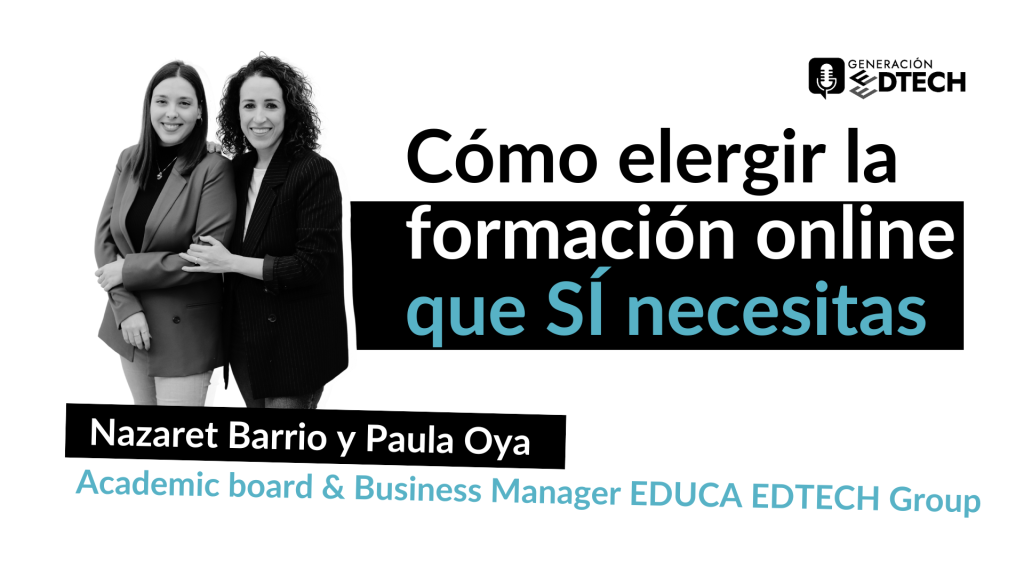
To this end, we spoke to Nazaret Neighbourhood y Paula O., experts in academic design and digital education. Drawing on their experience, we explore how to identify high-quality training programmes, which trends are shaping digital learning, and why the artificial intelligence It has become a key ally in personalised learning.
What to look for in a high-quality online course
Not everything offered in digital format guarantees a satisfactory educational experience. That is why this episode sets out the key factors that enable us to distinguish between useful training and an option that is not recommended:
- Content that is tailored to the labour market and constantly updated.
- Genuine access to tutors, teachers and personalised support.
- Flexible learning formats that adapt to each student’s pace: synchronous and asynchronous learning, microlearning and MOOCs.
- Official certifications or those endorsed by recognised institutions.
- Intuitive platforms, accessible from any device.
These characteristics are essential whether you are looking to retrain, enhance your skills or specialise professionally.
Artificial intelligence as a driver of personalisation
One of the central themes of the episode is the use of artificial intelligence in education. Far from replacing teachers, AI is presented as a a support tool that enhances the learning experience:
- It analyses behaviour and needs in order to propose personalised learning pathways.
- It makes assessment easier and reduces the administrative burden on teaching staff.
- It improves efficiency and enables content to be tailored to each student.
Thanks to AI, online learning can be more flexible, precise and useful for those who are studying whilst working or have family responsibilities.
Beyond the screen: training with a human touch
One of the most common misconceptions about digital training is the supposed lack of human contact. However, as the guests explain, behind good online training there is teaching, technical and student support teams which ensure a comprehensive learning experience.
Furthermore, many platforms utilise learning communities, active forums and spaces for discussion, which help to forge connections similar to those found in face-to-face training. The key lies in choose centres that prioritise interaction, support and personalised care.
Ongoing online training for an ever-changing world
Another major theme running through the episode is the need to view education as an ongoing process. It is no longer enough simply to complete a degree or a master’s degree and consider it finished. Today’s professional roles demand continuous upskilling, new transferable skills and the ability to adapt.
That is why short courses, audiovisual content, scalable learning pathways and the ability to learn via mobile devices are becoming established as essential tools for keeping up to date.