
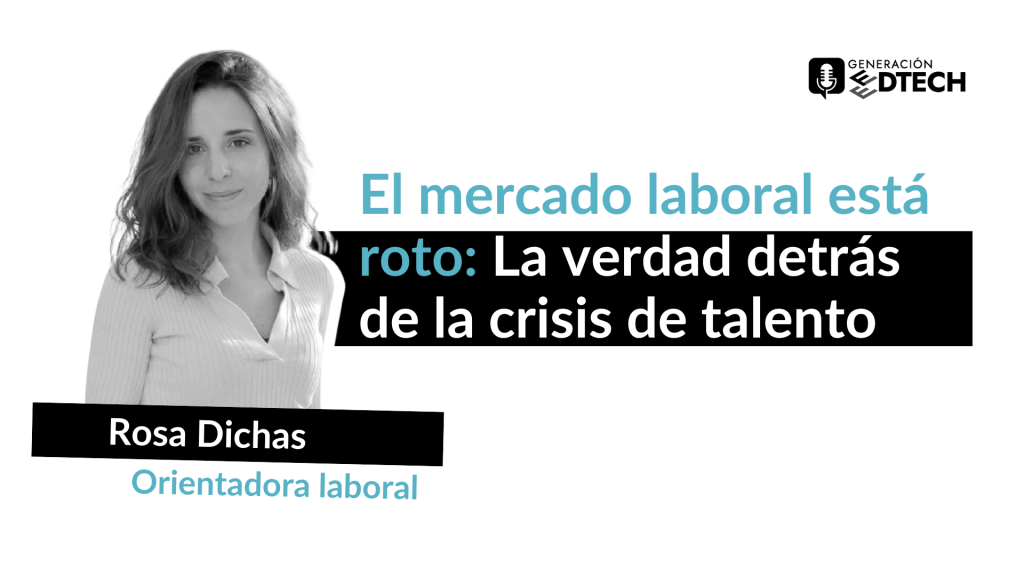
What makes a person employable these days? A university degree? A master’s degree? A good CV? According to Rosa Dichas, a labour lawyer and publiciser specialising in young people and work, True employability stems from a personal journey, not an academic checklist.
During his visit to EDTECH Generation, Rosa reminds us that today’s job market demands much more than just knowledge. It demands strategy, self-awareness and action. In other words: a personalised pathway to employability.
Context matters… but it isn’t everything
Spain has a high rate of youth unemployment. The conditions for entering the labour market are precarious and, for many, frustrating. But Rosa does not stop at simply identifying the problem. Her proposal involves stop thinking of employability as a destination and start designing it as a journey.
“Looking for a job isn’t just about checking LinkedIn every morning. It’s about connecting, getting involved and taking action.”
What is a personalised employability pathway?
It is a career plan that brings together three elements:
- Self-awareness: know what you want, what you’re good at and what you’re willing to learn.
- Information: to understand the market, employment rights, emerging sectors and genuine opportunities.
- Action: Try things out, practise, make mistakes, improve. Find an environment where your skills can meet a specific need.
This approach debunks the myth that a single qualification opens doors for you forever. According to Rosa, The key is being able to read the market and adapt quickly, without losing sight of who you are.
Soft skills and networking: tools for the new career path
During the interview, Rosa emphasises the importance of soft skills (communication, initiative, emotional management) and of the relational networks as a source of opportunities. Many opportunities aren’t listed on job sites: they’re in conversations, in projects, in connections.
That is why he encourages young people to build their network of contacts in a natural way, without being afraid to ask questions or seek advice. Employability does not depend solely on your education, but on your ability to present yourself and explain what you are capable of doing.
The journey isn’t linear… and that’s fine
More and more people are combining their studies with volunteering, entrepreneurship, temporary jobs or stays abroad. In contrast to the ideal of a “job for life”, Rosa proposes a more realistic and flexible approach:
“We must stop blaming young people for job-hopping. These days, carving out your own career path means moving around, trying things out and reinventing yourself.”
Conclusion
The future of work is not just about finding a job, but about know how to shape your own career path with sound judgement, knowledge and strategy. Design a personal pathway to employability It is now one of the most valuable skills we can develop.
And as Rosa points out, that journey always begins in the same place: Get to know yourself and take action. Because nobody’s going to know what you want unless you say so.