

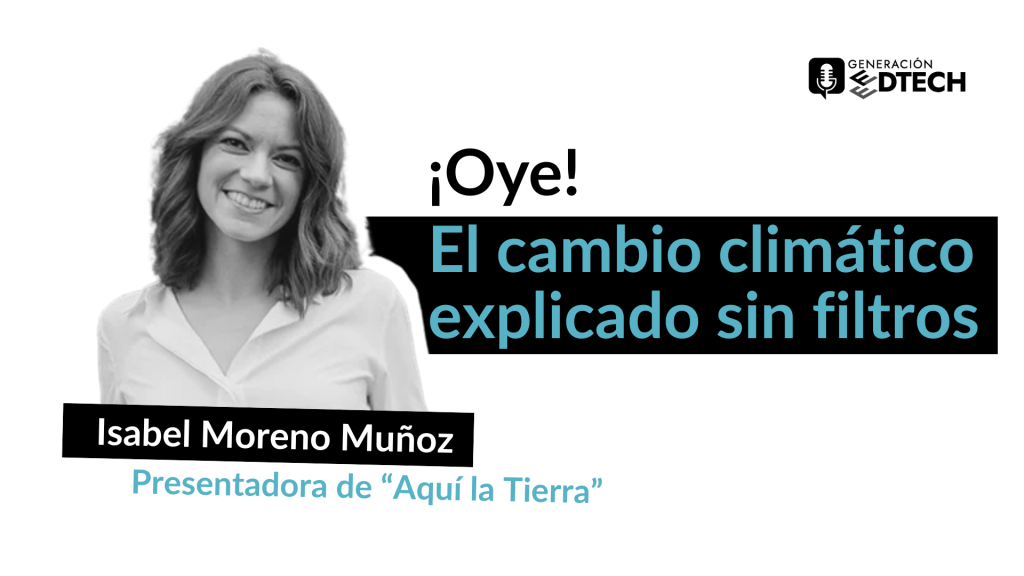
Every day we come across alarming headlines about the climate change, but how many of these news stories reflect reality? In EdTech Generation, we were joined by Isabel Moreno Muñoz, presenter of Here on Earth and an advocate for climate change awareness, with the aim of debunking some of the most widespread myths and offering a perspective grounded in scientific evidence.
The pace of change: An accelerating phenomenon
Past climate changes occurred over time scales spanning centuries or even millennia. However, the current change is taking place at an alarming rate. According to Isabel Moreno Muñoz, it is this pace that makes all the difference and turns it into a global problem.
“Never before has a species caused climate change on a global scale and at such a rapid pace as we are seeing today.” – Isabel Moreno Muñoz
This acceleration is having devastating effects on ecosystems, affecting both wildlife and human populations, particularly in vulnerable areas where extreme temperatures and natural disasters are already commonplace.
What is the news saying about climate change?
The media often highlight isolated incidents without providing the necessary context, whilst being immersed in a sea of fake news. Extreme weather events such as heatwaves, floods and forest fires are presented as isolated incidents when, in reality, they form part of a broader pattern linked to global warming.
Isabel Moreno Muñoz During the interview, he explained how many news reports perpetuate the idea that climate change is merely a natural cycle. However, scientific studies show that human activity is the main cause of accelerated global warming.
“News reports on climate change do not always reflect the scientific context. It is important to distinguish between one-off events and sustained trends over time.” – Isabel Moreno Muñoz
What can we do in the face of this reality?
Whilst the media can help raise awareness of the crisis, it is also necessary to foster a deeper understanding of the problem. Misinformation and myths can lead to a misguided perception of climate change and the solutions required.
Key actions:
- Consume information from verified sources.
- To promote environmental literacy in schools.
- To promote public policies that foster sustainability.
Conclusion: The responsibility to report accurately
The news about climate change They can be a double-edged sword: they raise awareness, but they can also misinform if they are not properly contextualised. Isabel Moreno Muñoz emphasises the importance of both the media and the public disseminating and consuming information based on scientific evidence. Only in this way can we tackle the crisis responsibly and with a sound understanding of the situation. strive to disseminate and consume information based on scientific evidence. Only in this way can we tackle the crisis responsibly and with a sound understanding of the situation.