

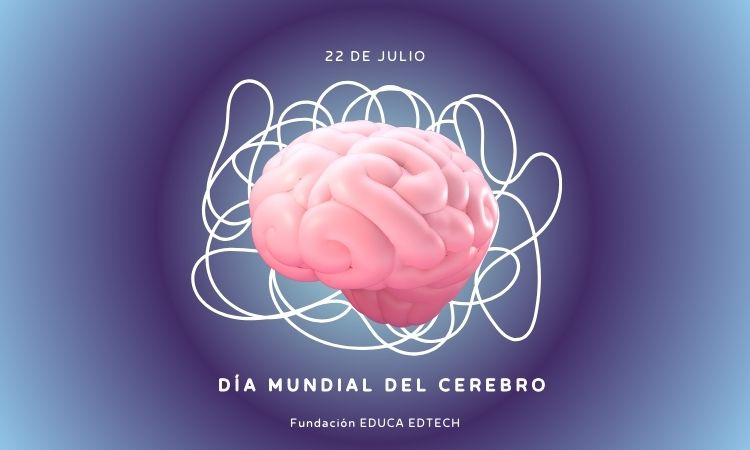
- 22 July marks the World Brain Day, and in EDUCA EDTECH Foundation We wanted to mark this very important day for raising awareness of mental health issues.
The origin of this World Brain Day It was in 2014 that the World Federation of Neurology set itself the aim of raising awareness of the importance of promoting neurological health.
A vital approach, given that more 43% of the world’s population suffers from some form of neurological disorder. And that’s not all, more than 3.4 billion people around the world live with some form of disability as a result of a neurological condition and more than 11 million people die every year due to any of these conditions.
Normalisation, empathy and support. The challenges of mental health
Last month, the podcast programme from the EDUCA EDTECH Foundation, , EDTECH Generation, devoted one of its programmes to the Granada-based association SAPAME.
SAPAME is an organisation formally established in 2005 by people living with some form of severe mental health condition, and is run and managed by the group itself. It has a clear objective: to foster, integrate and promote mental health from the perspective of recovery, empowerment and mutual support, Asunción Liñán, Chair of SAPAME, and José Domingo Morales, one of the organisation’s founding members, talk about the importance of mental health education and the stigmas that exist in society.
“When you’re diagnosed with a mental health condition, the first thing you think about is how to tell people. That’s something we work on at SAPAME: accepting your condition and normalising it so that people can accept it too.” says the chairwoman.
How can we look after our mental health?
In Spain, More than 23 million people suffer from a neurological condition, a significantly higher percentage (18%) than the global average.
We need to be aware that, according to mental health experts, almost half of all cases of dementia could be prevented by adopting habits that are good for our brains.
Among these healthy habits, we could highlight:
- Looking after your physical health
As we know, physical and mental health are closely linked. That is why, take part in physical activity It can reduce feelings of stress or depression and improve your mood.
Getting enough sleep, as not sleeping properly increases irritability and, in the long term, raises the risk of developing depression.
Similarly, the food is vital for our physical well-being. A good nutrition It can improve your mood and reduce anxiety and stress.
- Developing problem-solving skills
These are methods for dealing with stressful situations, which help us to tackle problems, take and develop action, be flexible and not give up easily when trying to solve problems.
- Meditation and relaxation techniques
These are practices that involve focusing one’s attention and inducing a natural relaxation response in the body.
To do this, you need a quiet place, to adopt a specific and comfortable posture, to practise your breathing and to keep an open mind.
It is also important to recognise when you need help and to seek therapy to improve your mental health.
“In our workshops, the professionals talk a lot about nutrition, eating healthily, doing sport and attending workshops, because these activities really help to develop social skills and boost self-esteem. We pick up basic tools for everyday life; they release endorphins and help relieve stress.” says José Francisco about the SAPAME workshops.