

A child’s smile reflects a future full of possibilities. However, in a hyper-connected world fraught with uncertainty, a happy childhood is by no means guaranteed. For many children in Spain and the rest of the world, the children’s rights are not yet fully respected. In this context, UNICEF plays a crucial role in promoting policies and programmes that protect children in an increasingly complex digital environment.
The impact of technology on children’s rights
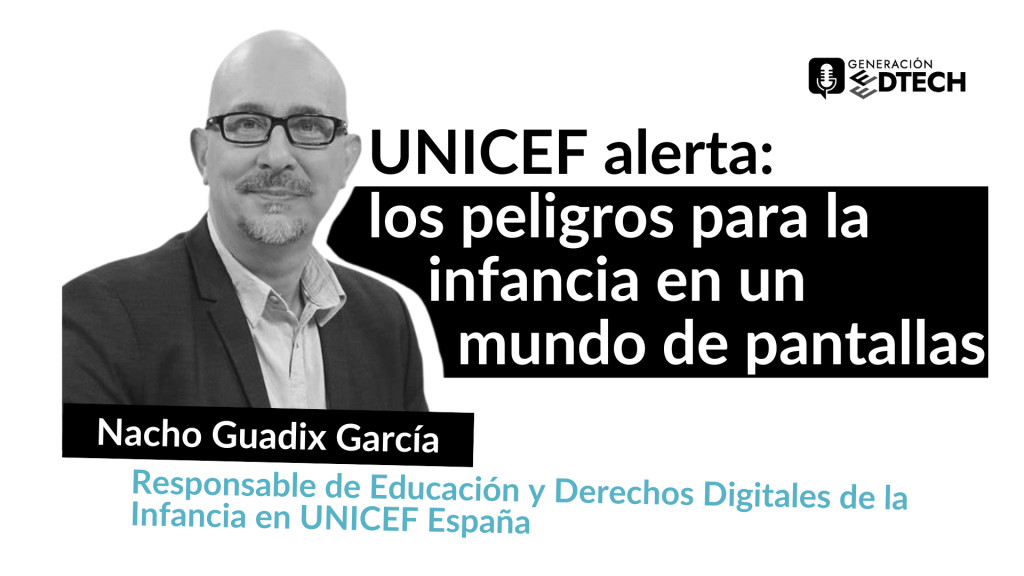
We live in a society where digital devices are part of the daily lives of millions of children. Although technology can be a powerful tool for learning and development, it also poses serious challenges to children’s rights. During the an episode of Generación EdTech with Nacho Guadix, UNICEF’s Head of Education, warned that excessive screen time can affect children’s emotional and social development.
“The right to a fulfilling childhood must include balanced access to technology, promoting children’s emotional wellbeing and holistic development.”
Are we respecting children’s digital rights?
Hyper-connectivity can directly affect fundamental rights such as the right to play, to interact with other children and to enjoy a stress-free childhood. UNICEF calls on families, schools and governments to put in place clear policies to ensure the safe and responsible use of technology by children.
How can families protect their children’s rights in the digital world?
Balance is key. Active supervision and the promotion of offline activities are essential to ensure that children do not miss out on opportunities for socialising and creativity due to excessive use of devices.
Shared responsibility: family, school and society
To ensure that the children’s rights In the digital age, this is no easy task. It requires the collaboration of families, educational institutions and public policies that put children at the centre. During the programme, Nacho Guadix emphasised that access to technology must go hand in hand with digital education so that children can learn to use technological resources safely and responsibly.
“Protecting children does not mean shielding them from technology, but rather teaching them how to use it responsibly.”
Conclusion: Digital rights, human rights
Children’s rights are not limited to the physical world; in the digital age, they must also be safeguarded online. UNICEF continues to work to ensure that children can enjoy a happy and safe childhood, both in the real world and in the virtual world. Committing to ethical and balanced digital education is the first step towards ensuring children’s wellbeing in an increasingly connected world.